Wednesday, March 28, 2018

Best tricks & tips for teaching English to beginners


Best tricks & tips for teaching English to beginners

Teaching beginners can be a daunting prospect, especially when it’s a monolingual

 group and you know nothing of their language, or it’s a multilingual group and

 the only common language is the English you’ve been tasked with teaching them. 

Nevertheless, not only is it possible...


Teaching beginners can be a daunting prospect, especially when it’s a monolingual group and you know nothing of their language, or it’s a multilingual group and the only common language is the English you’ve been tasked with teaching them. Nevertheless, not only is it possible to teach beginners only through English, but it can also be one of the most rewarding levels to teach. To help you succeed in setting your learners firmly on the path to increasing proficiency, here are seven tips for teaching English to beginners.

1. Keep instructions clear and simple

It can be tempting when addressing a class of students, especially ones that you’ve only just met, to explain activities in your politest language. After all, no one likes to be rude. However, a student who has only a few words of English, if any at all, won’t appreciate the courtesy of (or even understand), “OK, so now what I’d like you all to do, if you don’t mind, is just to stand up for a moment and come to the front of the class. Oh, and please bring your book with you. Could we all just do that?”
Instead, make instructions crystal clear by using as few words as necessary and by gesturing whenever possible, and break down series of instructions into smaller units. If you want to be polite, “please” and “thank you” will do. “Everybody – take your book, please. Stand up. Now, come here, please. Thank you.”

2. Let them listen first

More than likely, your students will want to start practising speaking pretty much from the get-go. However, it takes a while for one’s ear to acclimatise to the sounds of a new language, and not everyone will be so keen; don’t pressure students into speaking before they’ve had lots of opportunity to listen to you using it (which doesn’t mean you should just be rambling on at the front of the classroom – with beginners more so than with other levels, you really have to consider what you say and grade your language accordingly).

3. Drill, repeat, drill, repeat, drill…

Beginners need lots of repetition and drilling, especially as they get to grips with the sounds of their new language. It might seem boring to go over the same sentences again and again, but it is necessary. When practising a new sentence, try back-drilling, breaking the sentence down into manageable units and then building it back up, working backwards from the end of the sentence to the beginning; this helps to ensure that your intonation is natural and that you get elements of connected speech right. For example, break down “Would you like a cup of tea?” as follows:
tea > cup of tea > like a > like a cup of tea > Would you > Would you like a cup of tea?

4. Establish classroom language early on

Classroom language – Can you speak more slowly? What do we have to do? I don’t understand. What does… mean? How do you say… in English? – is usually associated with teaching children, but it really helps with adult beginners as well. No matter how friendly and relaxed you make your classroom atmosphere, learning a new language can still be daunting, especially when you feel you’re not completely following what’s going on, or that you might be called on to say something that you don’t feel ready to say. It’s much better to equip students early on with classroom language that will help them navigate the lesson smoothly.

5. Avoid metalanguage

There’s no point in students knowing the terms past simpleirregular verb or adverb of frequency if they can’t use the actual structures or words they refer to. Don’t tell them how to say something: show them. Give as much context as you can (visual prompts work well). Furthermore, make sure you check they have understood by asking questions that test their comprehension – never ask “Do you understand?” as a) many people are reluctant to let on that they haven’t understood and will pretend instead that they have; and b) a student may think they have understood when in fact they haven’t.

6. Don’t forget that your students are fluent in their own language(s)

This may seem a trivial point, but it’s all too easy when listening to somebody speaking broken English to forget that behind the errors and the mispronunciation is person with cogent thoughts, no doubt articulate in their first language, attempting to communicate his or her opinions or ideas.
As teachers, we not only have to be patient and proactive listeners, alert to the reasons why certain errors are being made while filling in the gaps in less-than-perfect communication, we also have to steer clear of adopting the Me-Tarzan-You-Jane approach to teaching, bastardizing the very language we are aiming to teach. Rather than degrading our language we have to grade it carefully so as to keep it comprehensible while maintaining its naturalness, rhythm and spirit, ensuring all the while that, as far as possible, we actually converse with our students and listen to what they have to say. After all, even from the very first lessons, from the ‘A’ in the alphabet and the ‘am’ of ‘to be’, communication is the goal.
What we should always avoid is this:

7. Prepare well, prepare a lot, keep them talking

Even though teaching beginners entails progressing slowly and recycling and repeating language many times, that doesn’t mean recycling the same activities, especially not during one lesson. Ensure you have a range of activities to use, and don’t go into class without having first carefully thought through how you are going to introduce new language, how you will check that the students have understood it, how you will practise it, and how you will deal with potential misunderstandings. The possibility for confusion at this level is much greater than at higher levels, and sometimes even harder to disentangle.
Also bear in mind that, unlike with higher levels, you can’t rely on conversations developing simply because the students don’t yet have the linguistic resources to engage in anything other than simple exchanges (though in time they will). This means that the onus will largely be on you to keep them talking.
Finally, enjoy this level. Although in many ways the hardest level to teach, it can also be one of the most satisfying. Seeing your learners go from knowing nothing to knowing a few words to knowing a few sentences and structures to being able to hold rudimentary conversations can be incredibly rewarding, and if they enjoy their initial exposure to the language, and feel confident and inspired to continue, then you will have helped pave the way to their further success.


Tuesday, March 27, 2018

Course N° 02

Course N° 02


In this wolrd there's trillions of species, we have a lot of wild animals; birds, fish, insects and mammals. We also have domesticated animals, and animals we keep as pets here's some of the famous and commun pets vocabulary that you may need in your daily English using :


HERE ARE SOME OF THE MOST COMMON ONES.

Picture of the Animal


GENERIC NAME


MALE


FEMALE


YOUNG


GROUP NAME


OTHER INFORMATION

MAMMALS
 It depends on the species - - -
badger
BADGER(S)
Boar
SowCub or KitColony(An old English name for a badger is a brock) They live in a set.
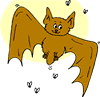
bat
BAT(S)
MaleFemalePupColonyBats are a protected species in the UK.
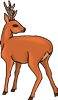
deer
DEER (DEER)
StagDoeFawnHerdA hart is a stag (usually a red deer) more than five years old, stag is more commonly used nowadays.
fox
FOX(ES)
Dog-fox / ReynardShe-fox / VixenCubSkulkFoxes live in an earth.
hare
HARE(S)
JackJillLeveretDownHares live in forms.
hedgehog
HEDGEHOG(S)
BoarSowPigletPrickle
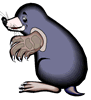
mole
MOLE(S)
MaleFemalePupLabourMoles live in holes.
mouse
MOUSE (MICE)
BuckDoePupNest
otter
OTTER(S)
DogBitchKittenFamilyOtters live in dens.
rabbit
RABBIT(S)
BuckDoeKit / BunnyColonyRabbits live in warrens.
rat
RAT(S)
BuckDoeKitten / PupNestRats often live in sewers.
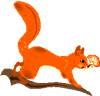
squirrel
SQUIRREL(S)
BuckDoePupDrayThere are two kinds of squirrel in the UK. The common grey squirrel and the rarer red squirrel. Only the red squirrel is a native.
stoat
STOAT(S)
JackJillKitPack
weasel
WEASEL(S)
JackJillKitSneak
BIRDS
Birds are feathered, winged, bipedal, warm-blooded, egg-laying, vertebrate animals.CockHen
Nestling / Hatchling/

Fledgling
Flock(s)Most birds live in nests.
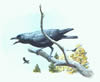
Crow
CROW(S)
MaleFemaleYoungMurder
dove
DOVE(S)
CockHenSquabCote
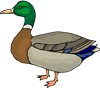
duck
DUCK(S)
DrakeHenDucklingFlock
goose
GOOSE (GEESE)
GanderGooseGoslingIf a group of geese is flying, it becomes a "skein". If they are on land or water, they're a "gaggle".
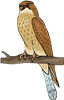
hawk
HAWK(S)
HenTiercelEyasAerie
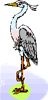
heron
HERON(S)
Hedge
kingfisher
KINGFISHER(S)
owl
OWL(S)
OwlJennyOwletParliament
peacock
PEAFOWL
PeacockPeahenPeachickPride
pheasant
PHEASANT(S)
CockHenChickBrood
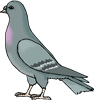
pigeon
PIGEON(S)
CockHenSquabFlight
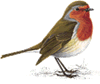
robin
ROBIN(S)
Cock
Hen
Chick
rook
ROOK(S)
Cock
Hen
Chick
Building
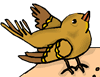
sparrow
SPARROW(S)
Cock
Hen
Chick
Flock
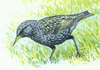
starling
STARLING(S)
Cock
Hen
Chick
Flock
swan
SWAN(S)
CobPenSignetBevy
INSECTS
An invertebrate whose body is comprised of three segments and six legs. - -Swarm -
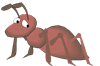
ant
ANT(S)
Prince / Drone
Queen / Princess / Worker
Antling
Army / Nest
Ants have a strange matriarchal set up. The Queen spends her life laying eggs, there is only one queen per colony. Worker ants are non-reproducing female worker ants, the daughters of the queen. Soldier ants are sterile females who defend the colony. The male ants are small ants that have wings. They fly from the colony to mate with a queen.
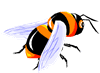
bee
BEE(S)
Drone
Queen / Worker
Larva
Hive
There are three types of honey bee. The Queen who lays the eggs. The workers are females who gather food, make honey, build the six-sided honeycomb, tend eggs, and guard the hive. And the drones are males who mate with the queen.
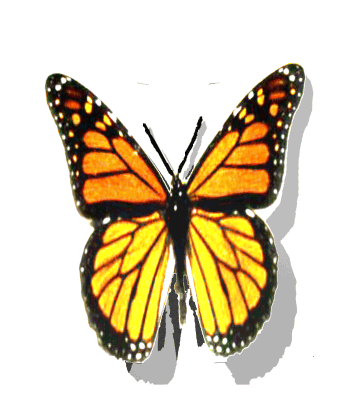
butterfly
BUTTERFLY (BUTTERFLIES)
MaleFemaleCaterpillar / ChrysalisSwarm
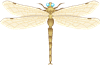
dragonfly
DRAGONFLY (DRAGONFLIES)
MaleFemaleNymphs / NaiadsSwarm
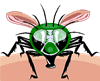
fly
FLY (FLIES)
MaleFemaleMaggotSwarm
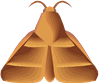
moth
MOTH(S)
MaleFemaleCaterpillar / ChrysalisSwarm
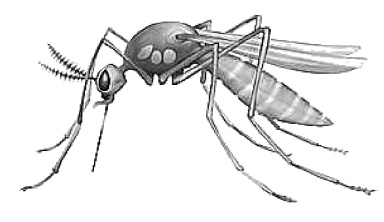
Mosquito
MOSQUITO(ES)
MaleFemaleLarvaSwarmThere are thousands of mosquito species. The female is the one that usually bites.
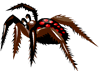
spider
SPIDER(S)
MaleFemaleSpiderlingClusterSpiders spin and live on a web. Thankfully the UK does not have any poisonous spiders.
FISH
Cold-blooded aquatic vertebrates usually having scales and breathing through gills. - - -Shoal / School
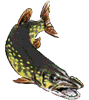
pike
PIKE
--FryShoal / School -
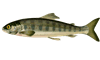
salmon
SALMON
JackHenFryRun -
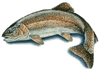
trout
TROUT
JackHenFryHover
AMPHIBIANS
A class of animals that spend part of their time on land and part in the water; they are an intermediate form between fishes and reptiles.
frog
FROG(S)
MaleFemaleTadpole(s)ArmyThe eggs of a frog are called spawn. Tadpoles metamorphose into frogs.
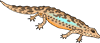
newt
NEWT(S)
MaleFemaleLarvae
toad
TOAD(S)
MaleFemaleTadpole(s)KnotThe eggs of a frog are called spawn. Tadpoles metamorphose into toads.
REPTILES
Cold-blooded vertebrate that lays eggs and has scales or plates on its skin - - - -
snake
SNAKE(S)
MaleFemaleYoungNestThere is only one poisonous snake in the UK; the adder.
CRUSTACEANS
A class of invertebrates that have a segmented body, a hard external skeleton (exoskeleton), two sets of antennae and one pair of legs per body segment. - -
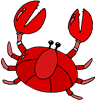
crab
CRAB(S)
MaleFemaleZoea
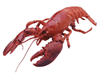
lobster
LOBSTER(S)
MaleFemaleZoea
MOLLUSCS
clam
CLAM(S)
MaleFemaleSpatBed
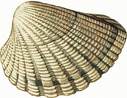
Cockle
COCKLE(S)
-
-
-
Bed
Cockles are hermaphroditic. A cockle will possess both male and female sex organs during its life
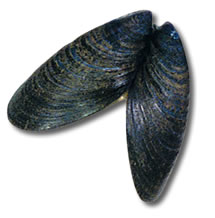
mussel
MUSSEL(S)
MaleFemaleGlochidiaBed
oyster
OYSTER(S)
MaleFemaleSpatBed
snail
SNAIL(S)
MaleFemaleBabyRoutSnails are not often eaten in the UK.

ANIMALS ON THE FARM

ANIMALS THAT LIVE ON A FARM ARE DOMESTICATED ANIMALS, THEY MAY BE CALLED FARM ANIMALS.
 
GENERIC NAME
MALE
FEMALE
YOUNG
GROUP NAME
OTHER INFORMATION
MAMMALS
cattle
CATTLE
BullCowCalfHerd / KineMostly farmed for milk and meat (called beef).
deer
DEER (DEER)
StagDoeFawnHerdDeer are farmed for their meat (venison) on special deer farms in the UK.
dog
DOG(S)
DogBitchPuppyPack (a group of puppies is called a litter)Mostly used for work, protection and herding on farms. Dog meat is not eaten in the UK.
donkey
DONKEY
JackJennyColtDroveMostly raised for pleasure. Donkey meat is not eaten in the UK.
goat
GOAT(S)
Billy
NannyKidFlockMostly farmed for milk and cheese. Not many people eat goat meat in the UK.
horse
HORSE(S)
StallionMareFoalHerdMostly farmed for work, leisure or sport (riding etc). Not many people in the UK would knowingly eat horse meat, although there is a trade for pet meat.
pig
PIG(S)
BoarSowPigletLitterMostly farmed for its meat (called pork).
sheep
SHEEP
RamEweLamb / MuttonFlockMostly farmed for wool and meat. The meat is called lamb from sheep less than a year old and mutton from older sheep.


BIRDS
chicken
CHICKEN(S)
CockerelHenChickBroodFarmed for its meat and eggs. A farm that only raises birds is a poultry farm.
duck
DUCK(S)
DrakeHenDucklingBraceA wild fowl and a farmed bird. Mostly farmed for its meat.
goose
GOOSE (GEESE)
GanderGooseGoslingGaggleA wild fowl and a farmed bird. Mostly farmed for its meat.
INSECTS

bee
BEE(S)
Drone
Queen / Worker
Larva
Swarm
Bees live in hives, and are farmed for their honey. A bee farm is often called an apiary. Someone who keeps bees is usually called a beekeeper.
FISH
salmon
SALMON
JackHenFryShoalYes, salmon is farmed in the UK.
trout
TROUT
JackHenFryShoalYes, there are trout farms in the UK too.

ANIMALS IN THE HOUSE

ANIMALS THAT LIVE IN THE HOUSE AS COMPANIONS ARE CALLED PETS.

 
GENERIC NAME
MALE
FEMALE
YOUNG
GROUP NAME
OTHER INFORMATION
MAMMALS
cat
CAT(S)
TomQueenKittenClutter (a group of kittens is called a litter)
dog
DOG(S)
DogBitchPuppyPackThere are between 6.5 million and 7.4 million pet dogs in the UK.
ferret
FERRET(S)
DogBitchKitCastDomestic pet ferrets, Mustela furo (sometimes called Mustela putorius furo), are not wild animals.
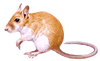
gerbil
GERBIL(S)
MaleFemalePupHorde
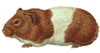
guinea pig
GUINEA PIG(S)
BoarSowPupGroupThey are not related to pigs.
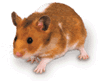
hamster
HAMSTER(S)
MaleFemalePupHordeI had several hamsters as pets when I was a child.
rabbit
RABBIT(S)
BuckDoeKit / BunnyColonyRabbits live in warrens.
rat
RAT(S)
BuckDoeKitten / PupNestSeemingly rats make very good pets.
BIRDS
budgie
BUDGERIGAR(S)
HenCockChickFlock
They come in a variety of colours including blue. One of the most common pets in the UK.
aka Budgie
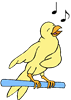
canary
CANARY (CANARIES)
HenCockChickFlock
cockatiel
COCKATIEL(S)
HenCockChickFlock
cockatoo
COCKATOO(S)
HenCockChickFlock
parrot
PARROT(S)
HenCockChickFlock
INSECTS

spider
SPIDER(S)
Male
Female
Spiderling
Cluster
Yes, people in the UK keep spiders as pets.
FISH
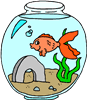
goldfish
GOLDFISH
Male
Female
Fry
Shoal
Probably the most common pet in the UK.
REPTILES
goldfish
SNAKE(S)
Male
Female
Baby
Nest
Yes, people in the UK keep snakes as pets too.


ANIMALS MAKE DISTINCT SOUNDS, SOME OF THESE SOUNDS HAVE THEIR OWN 
WORD. DO YOU NEED TO LEARN THESE? PROBABLY NOT, BUT YOU NEVER KNOW,
 ONE DAY YOU MIGHT THANK US.

  • Bees buzz.
  • Birds sing or tweet. Some birds caw.
  • Cats go miaow. They purr when they're happy.
  • Cockerels crow, or go cock-a-doodle-doo.
  • Cows go moo.
  • Dogs bark or go woof woof. They growl when they're angry.
  • Donkeys brayor go heehaw.
  • Ducks quack.
  • Flies buzz.
  • Frogs croak or go ribbit.
  • Geese honk.
  • Goats bleat.
  • Hens cluck.
  • Horses neigh.
  • Mice squeak.
  • Pigs oink or grunt or squeal.
  • Sheep bleat or go baa.
  • Snakes hiss.
  • Toads croak.